
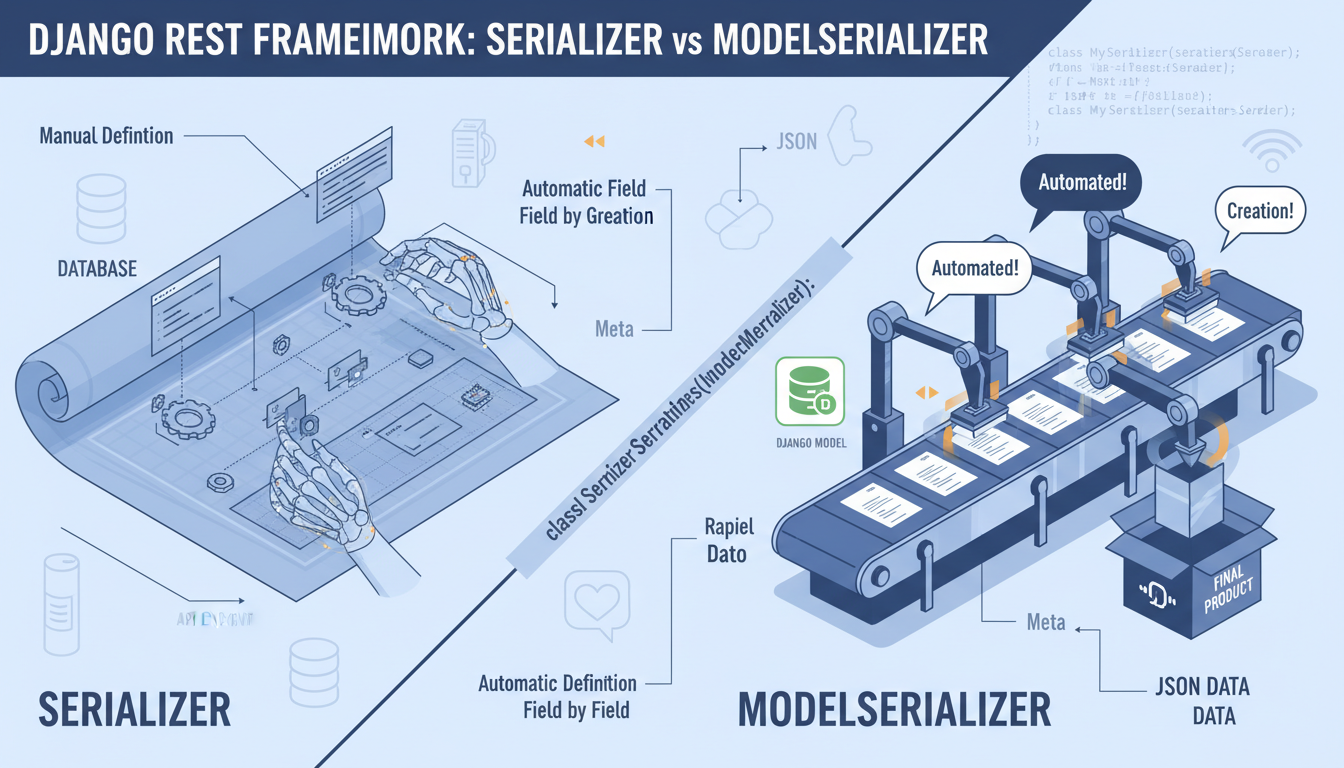
When building APIs with Django REST Framework (DRF), a common question developers face is whether to use a Serializer or ModelSerializer. While both are integral components of DRF, they serve slightly different purposes and come with their unique advantages. In this article, we’ll break down the differences between them, explore when to use each, and provide examples to help you make the right choice for your API development.
What is a Serializer?
In DRF, a Serializer is the most basic form of serialization. It allows you to convert complex Python objects (like Django models) into JSON format and vice versa. Serializers give you full control over how the data is converted, and they’re ideal for cases where you need fine-grained control over your API’s behavior.
Key Characteristics of a Serializer:
- Manual Field Definitions: You have to explicitly declare each field.
- Flexibility: Serializers are perfect when dealing with custom data sources, external APIs, or complex validation logic.
- Independence from Django Models: Unlike ModelSerializer, serializers are not tied to Django models, making them ideal for custom or external data sources.
Example of a Basic Serializer:
from rest_framework import serializers

class CommentSerializer(serializers.Serializer):
    id = serializers.IntegerField(read_only=True)
    text = serializers.CharField(max_length=200)
    created_at = serializers.DateTimeField()
In this example, we define each field manually, giving us full control over the serialization and deserialization processes. This is useful when your data doesn’t directly map to a Django model or when you need to work with a completely different data structure.
What is a ModelSerializer?
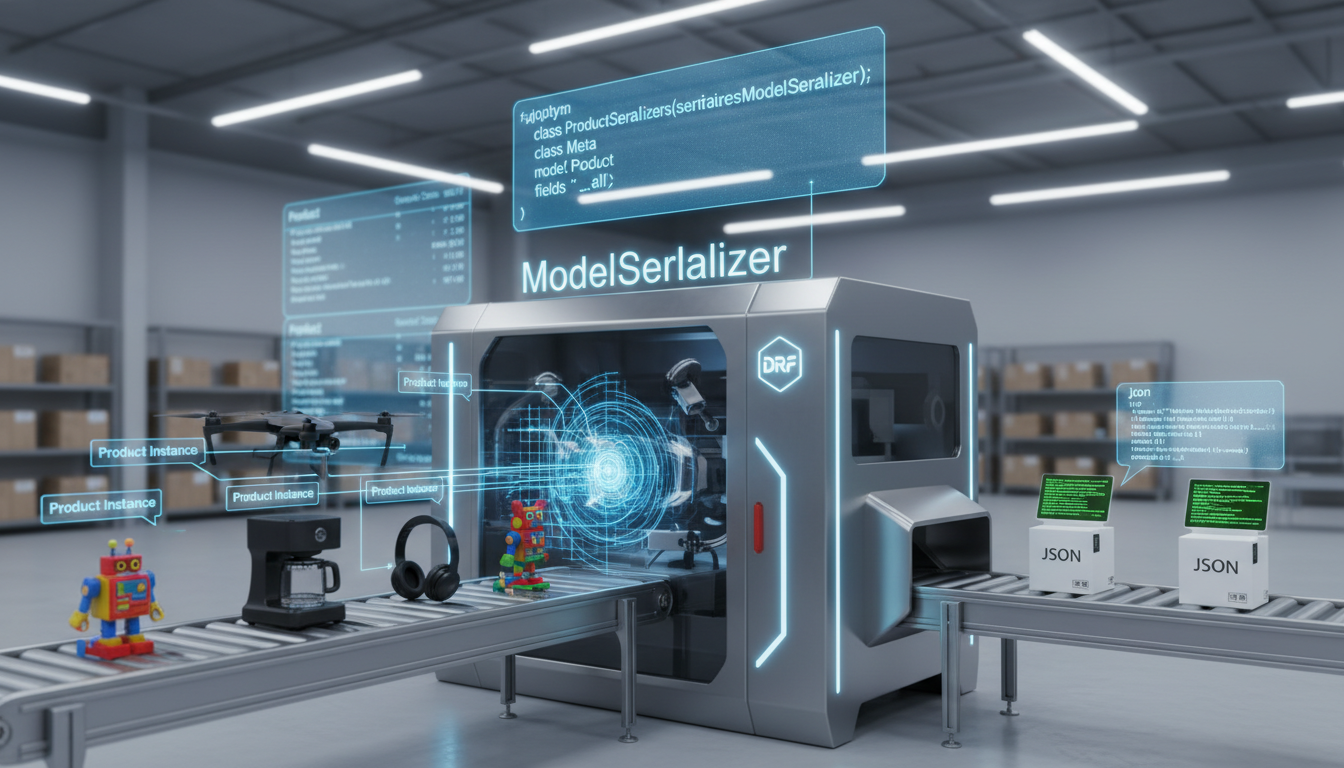
A ModelSerializer is a subclass of the standard Serializer that’s specifically designed to work with Django models. It automatically generates fields based on the model definition, significantly reducing boilerplate code. While it handles the bulk of the work for you, you still have the flexibility to override or add custom validation and logic when needed.
Key Characteristics of a ModelSerializer:
- Auto-Generated Fields: Automatically maps model fields to serializer fields based on the model definition.
- Reduced Boilerplate: You only need to specify which fields to include or exclude, saving time and effort.
- Customizability: You can still customize fields or add validation methods, and override model methods (e.g.,
clean()orsave()).
Example of a ModelSerializer:
from rest_framework import serializers
from .models import Comment

class CommentModelSerializer(serializers.ModelSerializer):
    class Meta:
        model = Comment
        fields = ['id', 'text', 'created_at']
In this example, the CommentModelSerializer automatically knows how to handle the Comment model. You don’t need to manually define each field—DRF does that for you. This makes it a more efficient choice when you’re dealing with data that directly correlates with Django models.
⚖️ When to Use Which?
The choice between Serializer and ModelSerializer largely depends on the nature of the data you’re working with. Here’s a quick guide to help you decide which one to use:
| Situation | Use Serializer | Use ModelSerializer |
|---|---|---|
| Data not tied to a Django model | ✅ | ❌ |
| You want full manual control | ✅ | ❌ |
| You want DRF to auto-generate fields from a model | ❌ | ✅ |
| Complex validation or custom logic | ✅ | ✅ (can override methods) |
| Rapid prototyping with models | ❌ | ✅ |
In summary:
- Use Serializer when:
- Your data is not directly tied to a Django model.
- You need fine control over serialization or have custom data structures.
- You’re dealing with external data sources or complex validation.
- Use ModelSerializer when:
- You’re working with Django models, and you want DRF to handle field generation automatically.
- You need to prototype quickly without writing excessive boilerplate code.
Validation Differences
Both serializers support validation, but the way validation is handled differs slightly between Serializer and ModelSerializer.
Serializer Validation:
In a Serializer, you manually define validation logic for each field or the entire serializer. For example, to prevent spam in a comment:
def validate_text(self, value):
    if "spam" in value.lower():
        raise serializers.ValidationError("No spam allowed!")
    return value
ModelSerializer Validation:
For a ModelSerializer, you can implement field-specific validation in a similar manner. Additionally, because the serializer is tied to a model, you can also rely on model-level validation, such as clean() methods or model field constraints.
class CommentModelSerializer(serializers.ModelSerializer):
    class Meta:
        model = Comment
        fields = ['id', 'text', 'created_at']

    def validate_text(self, value):
        if "spam" in value.lower():
            raise serializers.ValidationError("No spam allowed!")
        return value
Both serializers allow you to write custom validation logic, but the ModelSerializer makes use of both serializer-level and model-level validation methods, giving you a bit more flexibility.
Rule of Thumb
- Use ModelSerializer when you are working with Django models. It’s faster, cleaner, and reduces the need for writing repetitive code.
- Use Serializer when you need full manual control over how data is serialized, when the data is not tied to a Django model, or when you are dealing with external APIs or custom data sources.
Conclusion
Think of Serializer as a manual gearbox—everything is in your hands, and you control every detail of how the data is serialized. On the other hand, ModelSerializer is more like an automatic gearbox—most of the work is done for you, but you still have the option to override certain features when needed.
Ultimately, the choice between Serializer and ModelSerializer depends on your project’s requirements. If you’re working with Django models, ModelSerializer is typically the preferred choice. However, if you’re working with external data or need full control over your serialization process, Serializer will give you the flexibility you need.
By understanding the strengths and use cases for both serializers, you can make more informed decisions and streamline your API development process in Django REST Framework.



Leave a Reply